- Home
- Contact
- Landscape scale
- Workstreams
- Habitat condition monitoring
-
News
- Landscape Observatory, Big Chalk, and Buxton Climate Change Impacts Lab Explore Early-Stage Collaboration on Climate Change
- Landscape Observatory, Big Chalk, and Buxton Climate Change Impacts Lab Explore Early-Stage Collaboration on Climate Change
- Landscape Observatory to deliver AI-powered habitat mapping supported by Vodafone UK and National Parks Partnerships
- Plan Your Visit
Landscape Observatory, Big Chalk, and Buxton Climate Change Impacts Lab Explore Early-Stage Collaboration on Climate Change
Representatives from Landscape Observatory, Cranfield University and Big Chalk visited Buxton Climate Change Impacts Lab (BCCIL) to explore opportunities for collaboration on climate change.
Research at BCCIL is dedicated to investigating the impacts of climate change on the UK’s grassland ecosystems and how to maintain and protect its biodiversity for future generations. Originally established in 1993 by Philip Grime, the facility is the longest-running continuous climate change experiment globally. It is located on species-rich calcareous grassland on the outskirts of Buxton, Derbyshire, where experimental treatments have now been applied continuously to limestone grassland for 30 years.
“We were delighted to welcome colleagues from Big Chalk and Landscape Observatory. For 30 years, our experiments have been tracking grassland ecosystems under a changing climate. Sharing our accumulated knowledge and exploring how we can collaboration with the restoration work that Big Chalk is doing across southern England’s chalk and limestone landscapes generates real opportunity to amplify impact” said Dr Raj Whittlock, Buxton Climate Change Impacts Lab.
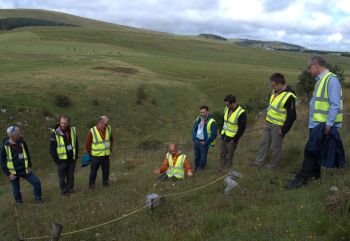
The lab manipulates the climate that the grassland experiences to evaluate the impact of three treatments including elevated winter temperatures, controlled summer drought and supplemented summer rainfall. Temperature and soil moisture are logged continuously, and all plots are subjected to simulated sheep grazing in October. BCCIL is recognised internationally as a unique resource for studying climate impacts on plants, soil microbes and fauna.
The visit gave Landscape Observatory, Cranfield University and Big Chalk the chance to see this globally significant site first-hand and to discuss how the wealth of research knowledge can be applied across the UK to help improve the quality and connectivity of species rich grasslands.
“BCCIL offers long-term evidence of how climate change is transforming ecosystems. Protected Landscapes will be able to use this research to help understand how the rapidly changing climate will impact grassland habitats and start to apply the Resist, Accept or Direct (RAD) framework within adaptive management planning process. Landscape Observatory is here to help with that transition away from static management plans ” said Simon Geikie, Director of Landscape Observatory.
While discussions are at an early stage, the organisations are exploring opportunities to share knowledge, co-develop projects and communicate the impacts of climate change across UK landscapes. Linking cutting edge and long term science to action and impact on the ground.
Notes to Editors
Note to editors
The Buxton Climate Change Impacts Lab (BCCIL) was established in 1993 and is the longest-running continuous climate change experiment globally. The facility is a collaboration between University of Sheffield and Lancaster University. For more information please visit Buxton Climate Change Impacts Lab
Landscape Observatory is supported through the Protected Landscape Partnership Incubator Hub and provides a platform for advancing the latest critical thinking in conservation management. It develops Adaptive Management plan approaches, focused on the impact of climate change, to give clear direction and a framework for demonstrating effective management. For more information please visit Landscape Observatory
Big Chalk, also supported by the Protected Landscape Partnership Incubator Hub, is a partnership of more than 150 organisations working to restore and protect southern England’s chalk and limestone landscapes, covering 30% of the country. For more information please visit Big Chalk